AI systems as digital public goods - a dive into what this means from a slightly more technical perspective
May 21, 2025
Ricardo Mirón Torres, Chief Technology Officer, DPGA Secretariat
Theo: https://www.digitalpublicgoods.net/blog/ai-systems-as-dpgs
Bài được đưa lên Internet ngày: 21/03/2025
DPGA hiện đang tiếp nhận hồ sơ đăng ký cho các hệ thống AI! Bài viết này cung cấp cái nhìn tổng quan thực tiễn cùng mô tả chi tiết về các yêu cầu nêu trong Tiêu chuẩn DPG (DPG Standard) mà một hệ thống AI cần đáp ứng để được công nhận là hàng hóa công kỹ thuật số - DPG (Digital Public Good) và được liệt kê trong Danh mục DPG (DPG Registry).
Chúng ta đã đi đến đây như thế nào?
Một hàng hóa công kỹ thuật số (DPG) không chỉ đơn thuần là phần mềm mở, dữ liệu mở, bộ sưu tập nội dung mở hay hệ thống AI mở. Các DPG là những giải pháp nguồn mở, đồng thời phải đảm bảo tính dễ tiếp cận, khả năng thích ứng và được thiết kế theo nguyên tắc "không gây hại". Do đó, để được công nhận là DPG, một giải pháp phải chứng minh được sự tuân thủ Tiêu chuẩn DPG. Điều này đảm bảo rằng các yếu tố quan trọng nêu trên được tích hợp vào thiết kế của giải pháp kỹ thuật số, từ đó tạo điều kiện cho việc triển khai công nghệ một cách an toàn và mang lại tác động lớn hơn.
Vào năm 2023, trước tiềm năng to lớn của AI đối với sự phát triển cũng như những rủi ro đi kèm, Ban Thư ký DPGA đã phối hợp cùng UNICEF thành lập một Cộng đồng Thực hành - CoP (Community of Practice) chuyên biệt về các hệ thống AI. Nhóm này được tập hợp nhằm xem xét cách thức điều chỉnh Tiêu chuẩn DPG sao cho phù hợp hơn trong việc xác định các hệ thống AI dưới dạng một loại hình DPG, đồng thời khám phá mối giao thoa giữa AI mở và AI có trách nhiệm.
Bên cạnh một loạt khuyến nghị của CoP về hệ thống AI, Ban Thư ký DPGA đã giám sát chặt chẽ và tham gia vào các cuộc trò chuyện liên quan cũng đang diễn ra. Điều này bao gồm Định nghĩa AI nguồn mở (OSAID) của OSI (bản dịch sang tiếng Việt), Khung Tính mở Mô hình (MOF) của Quỹ Linux (bản dịch sang tiếng Việt) và các cuộc tham vấn với các thành viên DPGA đang tích cực làm việc về AI, chẳng hạn như OpenFuture, Creative Commons và Quỹ Tri thức mở.
Sau giai đoạn bình luận mở trên GitHub, Hội đồng Tiêu chuẩn DPG đã xem xét cẩn thận các ý kiến đầu vào được đưa ra trong suốt quá trình này và, như một phần của bộ cập nhật cho Tiêu chuẩn DPG, đã đưa ra các thay đổi nhằm tăng cường tính minh bạch và trách nhiệm giải trình của các DPG hệ thống AI đồng thời đảm bảo rằng chúng đáp ứng các yêu cầu nhất quán trên tất cả các danh mục DPG.
Vậy hệ thống AI là gì?
Trước khi đi sâu vào các bản cập nhật cụ thể, bạn cần hiểu rõ ý nghĩa của “hệ thống AI” (AI system) vì nó có ý nghĩa đối với các thành phần phải tuân thủ Tiêu chuẩn DPG. Chúng tôi công nhận hệ thống AI là hệ thống dựa trên máy được thiết kế để hoạt động với nhiều cấp độ tự chủ khác nhau, có thể đưa ra dự đoán, đề xuất hoặc quyết định ảnh hưởng đến môi trường thực hoặc ảo đối với một nhóm mục tiêu nhất định do con người xác định hoặc tạo ra kết quả đầu ra, chẳng hạn như văn bản, hình ảnh hoặc âm thanh.
Cách hiểu này phù hợp với các hướng dẫn của OECD về AI (Khuyến nghị của Hội đồng Trí tuệ Nhân tạo, Nhà xuất bản OECD, Paris, 2019)
Để được công nhận là trạng thái DPG, hệ thống AI phải cung cấp các thành phần sau đây cùng với các yêu cầu sau:
Thành phần | Mô tả | Giấy phép được chấp nhận |
| Dữ liệu | [1] (Các) bộ dữ liệu được sử dụng để để huấn luyện, xác thực và kiểm thử hệ thống. | [1] Các giấy phép tuân thủ Định nghĩa Mở |
| Mã nguồn | [2] Mã nguồn được sử dụng cho các công đoạn tiền xử lý, huấn luyện, xác thực và kiểm thử dữ liệu. [3] Các thành phần mã nguồn khác, chẳng hạn như mã thực thi suy luận, các thư viện và các công cụ hỗ trợ. | [2][3] Các giấy phép được OSI phê duyệt |
| Mô hình | [4] Kiến trúc mô hình, loại mô hình, các lớp và cấu trúc. [5] Các tham số mô hình, chẳng hạn như trọng số, bộ tối ưu hóa, hệ số và các siêu tham số khác có liên quan. | [4] Các giấy phép được OSI phê duyệt [5] Các điều khoản tuân thủ định nghĩa Nguồn Mở |
Những yêu cầu này đồng nghĩa với việc mọi dữ liệu được sử dụng trong một hệ thống AI đều phải ở dạng mở và có thể truy cập được. Chúng tôi hiểu rằng đây là một tiêu chuẩn rất cao, có thể làm hạn chế số lượng các hệ thống AI đáp ứng được Tiêu chuẩn DPG (DPG Standard). Tuy nhiên, chúng tôi cho rằng điều này rất quan trọng, vì nó củng cố các nguyên tắc cốt lõi của DPGA.
Việc tiếp cận dữ liệu không chỉ góp phần thúc đẩy lợi ích công cộng, mà còn khẳng định cam kết mạnh mẽ của chúng tôi đối với tính mở – yếu tố hỗ trợ cho trách nhiệm giải trình, tính an toàn và mang lại những lợi ích thiết thực cho xã hội. Bạn có thể tìm hiểu thêm về lý do chúng tôi đưa ra quan điểm này thông qua các bài viết trên blog của chúng tôi về vai trò của dữ liệu mở trong AI và tầm quan trọng của nó đối với các hệ thống AI phục vụ lợi ích công cộng.
Điều này có ý nghĩa gì đối với tài liệu hướng dẫn?
Một trong những lợi ích được đánh giá cao nhất của các DPG (Hàng hóa Công cộng Kỹ thuật số) chính là khả năng tái sử dụng. Để đạt được điều này, cần có tài liệu hướng dẫn rõ ràng, giúp một người có chuyên môn kỹ thuật – dù chưa từng biết đến hệ thống AI cụ thể đó – vẫn có thể hiểu, sử dụng và tùy chỉnh nó. Đây cũng là lý do tại sao, bên cạnh các yêu cầu hiện có đối với tài liệu phần mềm nói chung, chúng tôi bổ sung thêm các yêu cầu cụ thể liên quan đến tài liệu về dữ liệu và mô hình.
Mặc dù hiện đã có nhiều mẫu tài liệu dành cho mô hình (model cards) và bảng dữ liệu (datasheets), chúng tôi vẫn duy trì sự linh hoạt. Tài liệu có thể được gửi dưới nhiều định dạng khác nhau, miễn là đảm bảo chứa tối thiểu các thông tin sau đây.
Thông tin | Mô tả |
Mô hình | Tổng quan về mô hình Tên gọi, phiên bản, ngày tháng, nhà phát triển, mô tả và thông tin liên hệ.
Mục đích sử dụng Các mục đích sử dụng chính, đối tượng người dùng dự kiến và các ứng dụng nằm ngoài phạm vi sử dụng.
Các chỉ số hiệu suất Các chỉ số đánh giá định lượng quan trọng, độ chính xác, độ chuẩn xác, độ thu hồi (recall) và những chỉ số hiệu suất liên quan khác.
Các hạn chế Những điểm yếu đã biết, các dạng lỗi có thể xảy ra và các thành kiến (bias) tiềm ẩn. |
Dữ liệu | Tổng quan về dữ liệu Tên/định danh tập dữ liệu, phiên bản và ngày tháng, người tạo/người duy trì, các trường hợp sử dụng cùng những thông tin chung khác.
Thông tin kỹ thuật Nguồn gốc dữ liệu, từ điển dữ liệu, lược đồ dữ liệu, mã định danh duy nhất, mối liên kết với các hệ thống thuật ngữ (ontology) hoặc từ vựng chuyên ngành, chất lượng dữ liệu và các hạn chế.
Thành phần và đặc điểm của tập dữ liệu Các thực thể dữ liệu, số lượng thực thể, định dạng dữ liệu, các trường/đặc trưng dữ liệu, nhãn/biến mục tiêu (nếu có), phân chia tập dữ liệu (nếu có).
Thu thập và tiền xử lý dữ liệu Các nguồn dữ liệu, quy trình thu thập, các bước làm sạch và tiền xử lý dữ liệu, cùng công tác gán nhãn dữ liệu. |
Các cân nhắc về AI có trách nhiệm
Dựa trên các thông lệ tốt nhất và kế thừa từ "Khuyến nghị về Đạo đức trong Trí tuệ nhân tạo" của UNESCO (bản dịch sang tiếng Việt), chúng tôi đã đưa ra những yêu cầu cụ thể về cách các hệ thống AI cần dự đoán, ngăn ngừa và đảm bảo không gây hại ngay từ khâu thiết kế.
Các nhà phát triển phải cung cấp thông tin về việc cân nhắc rủi ro trong quá trình xây dựng hệ thống AI – cụ thể là cách thức kiểm thử các yếu tố như định kiến, sự công bằng, tính minh bạch và bảo mật – cũng như việc triển khai các biện pháp giảm thiểu phù hợp nếu phát hiện nguy cơ gây hại. Theo đó, các yêu cầu tối thiểu sau đây phải được đáp ứng:
Thông tin | Mô tả |
| Tính cân xứng | Tác động đối với con người và các nhóm dễ bị tổn thương, sự tham gia của các bên liên quan, các nguyên tắc được tuân thủ, v.v. |
| Định kiến và Công bằng | Các bước giám sát, giảm thiểu và giải quyết tình trạng thiên kiến, đánh giá tính công bằng, các ngưỡng thiết lập cho mô hình, v.v. |
| Rủi ro và Tác hại | Các bài kiểm tra xác thực, vấn đề lạm dụng hoặc sử dụng sai mục đích, các cân nhắc về đạo đức, các cơ chế kiểm soát an toàn (guardrails), v.v. |
| Các biện pháp giảm thiểu | Đánh giá độ chính xác, xác thực mô hình và đảm bảo chất lượng, tính bền vững và bảo mật, công tác giám sát và kiểm soát, v.v. |
| Tính minh bạch | Khả năng giải thích của mô hình, logic và quy trình ra quyết định, thông tin dành cho người dùng, gắn nhãn nội dung do AI tạo ra, v.v. |
Việc sử dụng các khuôn khổ toàn diện hơn để đánh giá rủi ro và trách nhiệm liên quan đến AI là điều được khuyến khích, nhưng không phải là yêu cầu bắt buộc để được công nhận là Hàng hóa công kỹ thuật số – DPG (Digital Public Good).
Đây chỉ là điểm khởi đầu
Mặc dù chúng tôi cố gắng giữ cho các yêu cầu và định nghĩa có phạm vi áp dụng rộng rãi nhất có thể, chúng tôi hiểu rằng các hệ thống AI không phải là một công nghệ đơn lẻ, mà là một lĩnh vực bao quát với nhiều kỹ thuật và mức độ phức tạp khác nhau. Từ các mô hình máy học truyền thống cho đến AI tạo sinh (generative AI), chúng tôi sẽ liên tục đánh giá và cập nhật Tiêu chuẩn DPG của mình khi cần thiết.
Các định nghĩa và cập nhật đối với Tiêu chuẩn DPG này tương thích với các yêu cầu của OSI (Open Source Initiative) về việc thực thi các quyền tự do cơ bản của AI nguồn mở, cũng như khuôn khổ "Model Openness Framework" (Khuôn khổ về tính mở của mô hình) – Hạng I (Mô hình khoa học mở). Điều này biến quy trình đề cử DPG thành một cơ chế thực tiễn để đánh giá mức độ tuân thủ đối với nhiều tiêu chí về tính mở khác nhau.
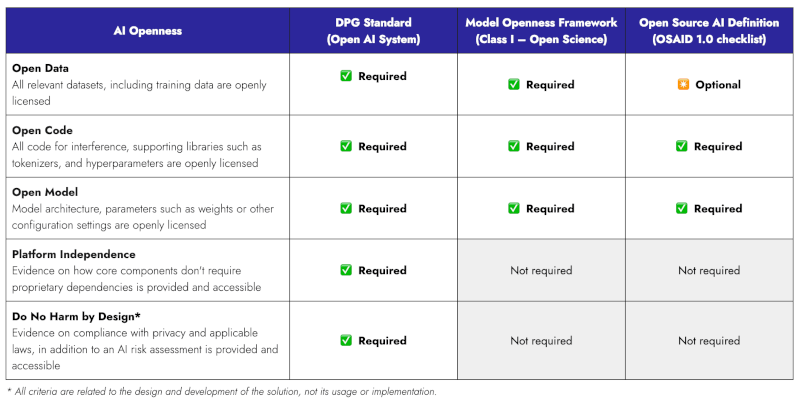
Biểu đồ này cung cấp cái nhìn tổng quan về những điểm tương đồng cũng như khác biệt giữa Tiêu chuẩn DPG (DPG Standard) với các sáng kiến khác trong việc định nghĩa trí tuệ nhân tạo (AI) nguồn mở (Open Source AI).
Chúng tôi xin gửi lời cảm ơn đến tất cả các cá nhân và tổ chức đã đóng góp vào quá trình hoàn thiện Tiêu chuẩn DPG, giúp chúng tôi đánh giá các hệ thống AI theo tiêu chuẩn này một cách hiệu quả hơn. Cũng như mọi hoạt động khác tại DPGA, đây không phải là nỗ lực của riêng cá nhân hay tổ chức nào.
Chúng tôi rất hào hứng khi mở ra một chương mới: công nhận các hệ thống AI là DPG, bởi chúng đóng vai trò quan trọng đối với tương lai của quá trình chuyển đổi số trên toàn cầu. Chúng tôi tin rằng việc tiếp cận các hệ thống AI một cách cởi mở, minh bạch và an toàn không chỉ khả thi mà còn vô cùng thiết yếu. Chúng tôi khuyến khích các nhà phát triển hệ thống AI — những người tin rằng giải pháp của mình có thể tạo ra tác động tích cực và đáp ứng các tiêu chí để được công nhận là DPG — hãy tham gia cùng chúng tôi bằng cách gửi thông tin hệ thống đó vào Danh mục DPG (DPG Registry)!
The DPGA is now accepting submissions for AI systems! This post provides a practical overview and detailed description of the requirements outlined in the DPG Standard that an AI system must meet to be recognized as a digital public good and listed on the DPG Registry.
How we got here ?
A digital public good (DPG) entails much more than simply being open software, open data, an open content collection, or an open AI system. DPGs are open-source solutions that must also be accessible, adaptable, and designed to do no harm. Therefore, to be recognised as a DPG, a solution must demonstrate adherence to the DPG Standard to ensure those important elements are embedded into the design of a digital solution and, by doing so, can facilitate more impactful and safe technology deployment.
In 2023, recognising both the immense potential of AI for development as well as the risks associated with it, the DPGA Secretariat, in collaboration with UNICEF, convened a dedicated Community of Practice (CoP) on AI systems. This group was brought together to specifically examine how the DPG Standard may need to adapt to better determine what constitutes AI systems as a type of DPG and to explore the intersection between open and responsible AI.
Alongside a set of recommendations from the CoP on AI systems, the DPGA Secretariat closely monitored and participated in relevant conversations that were also taking place. This included the OSI's Open Source AI Definition (OSAID), the Linux Foundation’s Model Openness Framework (MOF), and consultations with DPGA members actively working on AI, such as OpenFuture, Creative Commons, and the Open Knowledge Foundation.
Following an open commenting period on GitHub, the DPG Standard Council carefully considered inputs surfaced throughout this process and, as part of a set of updates to the DPG Standard, introduced changes to strengthen the transparency and accountability of AI system DPGs while ensuring that they meet consistent requirements across all DPG categories.
What's an AI system, anyway?
Before diving into the specific updates, it’s valuable to provide an understanding of what is meant by “AI system,” as it has implications for the components that must be DPG Standard compliant. We recognise AI systems as machine-based systems designed to operate with varying levels of autonomy that can, for a given set of human-defined objectives, make predictions, recommendations, or decisions influencing real or virtual environments, or generate outputs, such as text, images, or sounds.
This understanding aligns with OECD guidelines on AI (Recommendation of the Council on Artificial Intelligence, OECD Publishing, Paris, 2019)
In order to be recognised as a DPG status, AI systems must provide the following components, alongside the following requirements:
Component | Description | Accepted Licenses |
| Data | [1] The dataset(s) used to train, validate, and test the system. | [1] Conformant licenses to the Open Definition |
| Code | [2] The code used for data pre-processing, training, validation, and testing. [3] Other code elements, such as inference, supporting libraries, and tools. | [2][3] OSI-approved licenses |
| Model | [4] The model architecture, type of model, layers, and structure. [5] The model parameters, such as weights, optimizers, coefficients, and other applicable hyperparameters. | [4] OSI-approved licenses [5] OSD-conformant terms |
These requirements mean that all data used in an AI system must be open and available. We acknowledge that this is a high bar to set, and it may restrict the number of AI systems that meet the DPG Standard. However, we consider this important, as it reinforces the DPGA’s core beliefs. Access to the data further contributes to advancing the public good, while underscoring our firm commitment to openness that supports accountability, safety, and meaningful societal benefits You can read more about how we arrived at this position in our blogs on the role of open data in AI and its relevance for public interest AI.
What does this mean for documentation?
One of the most valued benefits of DPGs is their potential for reuse. To enable this, clear documentation is needed so that a technically skilled person—who may be unfamiliar with the specific AI system—can understand, use, and adapt it. This is also why, alongside the existing requirements for general software documentation, we now include specific requirements related to documentation of data and models.
While multiple templates for model cards and datasheets exist, we aim to be flexible. Documentation can be submitted in different formats, as long as it contains the following information at a minimum.
Information | Description |
Model | Model Overview Name, version, date, developer, description, and contact information. Intended Use Primary intended uses, intended users, and out-of-scope applications. Performance Metrics Key quantitative evaluation metrics, accuracy, precision, recall, and other relevant performance indicators. Limitations Known weaknesses, failure modes, and potential biases. |
Data | Data Overview Dataset name/identifier, version, and date, creator/maintainer, use cases, and other general details. Technical Details Data provenance, data dictionary, data schema, unique identifiers, crosswalks to ontologies or vocabularies, data quality, and limitations. Dataset Composition and Characteristics Data instances, number of instances, data format, data fields/features, labels/target variables (if applicable), data splits (if applicable). Data Collection and Preprocessing Data sources, collection process, data cleaning and preprocessing steps, and data labeling. |
Responsible AI considerations
Following best practices and building on top of UNESCO's Recommendation on the Ethics of Artificial Intelligence, we have also introduced specific requirements for how AI systems anticipate, prevent, and do no harm by design.
Developers must provide information on how risk was considered during the development of the AI system - specifically how it was tested for bias, fairness, transparency, security - and whether appropriate mitigation measures were implemented if potential harm was identified. As a result, the following minimum requirements must be met:
Information | Description |
| Proportionality | Impact on people and vulnerable groups, engagement with stakeholders, principles followed, etc. |
| Bias and Fairness | Steps to monitor, mitigate, and address biases, fairness assessment, model thresholds, etc. |
| Risks and Harms | Validation tests, misuse or unintended use, ethical considerations, guardrails, etc. |
| Mitigations | Accuracy evaluation, model validation and quality assurance, robustness and security, oversight and control, etc. |
| Transparency | Model explainability, logic, and decision-making, user information, tagging AI-generated content, etc. |
Using more comprehensive frameworks for AI risk and responsibility assessments is encouraged, but not required for DPG recognition.
It's a Starting Point
While we try to keep requirements and definitions as broadly applicable as possible, we acknowledge that AI systems are not a single technology, but rather a broad field encompassing various techniques and levels of complexity. From more traditional machine learning models to generative AI, we will continuously evaluate and evolve our DPG Standard as necessary.
These definitions and updates to the DPG Standard are compatible with OSI’s requirements to exercise the basic freedoms of Open Source AI as well as the Model Openness Framework Class I – Open Science Model, making the DPG nomination an operational process for evaluating compliance against multiple specifications of openness.
This chart provides a quick look at how the DPG Standard is similar to, yet distinct from, other initiatives defining open-source AI.
We would like to thank all the individuals and organisations who have helped shape how we are evolving the DPG Standard to better assess AI system DPGs. Like everything we do at the DPGA, this was far from an independent endeavour.
We are excited to begin a new chapter of accepting AI systems as DPGs, as we know they have an important role to play in the future of digital transformation worldwide. We believe that open, transparent, and safe access to AI systems is not only possible, but essential. We encourage any developer of an AI system who believes their solution can make an impact and may be eligible for DPG recognition to join us by submitting it to the DPG Registry!
Dịch: Lê Trung Nghĩa
letrungnghia.foss@gmail.com