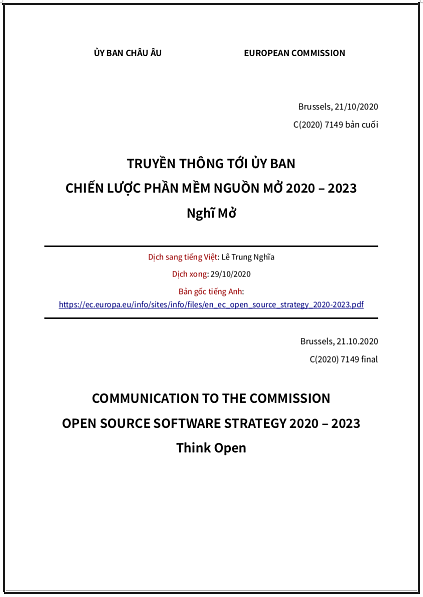
Open
source software strategy
Theo:
https://ec.europa.eu/info/departments/informatics/open-source-software-strategy_en
Ủy
ban châu Âu sẽ tiếp tục khuyến khích và tận dụng
tiềm năng chuyển đổi quá độ, đổi mới sáng tạo và
cộng tác của nguồn mở. Chiến lược
được làm mới cho giai đoạn 2020-2023 nhấn mạnh đặc
biệt vào việc chia sẻ và sử dụng lại các giải pháp
phần mềm, tri thức và sự tinh thông cũng như vào việc
gia tăng sử dụng nguồn mở trong công nghệ thông tin
(CNTT) và các lĩnh vực chiến lược khác.
Chiến
lược phần mềm nguồn mở 2020-2023
Vào ngày
21/10/2020, Ủy ban châu Âu đã
phê chuẩn Chiến lược
Phần mềm Nguồn Mở mới cho giai đoạn 2020-2023 của
Ủy ban. Đây là bước quan trọng hướng với việc đạt
được các mục tiêu Chiến
lược Số tổng thể của Ủy ban và đóng góp cho
chương trình châu Âu Số.
Chiến lược trong
nội bộ, theo chủ đề “Hãy nghĩ mở”, đặt ra tầm
nhìn khuyến khích và tận dụng sức mạnh có tính chuyển
đổi quá độ, đổi mới sáng tạo và cộng tác của
nguồn mở, các nguyên tắc và các thực hành phát triển
của nó. Nó thúc đẩy việc chia sẻ và sử dụng lại
các giải pháp phần mềm, tri thức và sự tinh thông, để
phân phối các dịch vụ châu Âu tốt hơn, có lợi cho xã
hội và giảm các chi phí cho xã hội. Ủy ban cam kết gia
tăng sử dụng nguồn mở của nó không chỉ trong các lĩnh
vực thực hành như CNTT, mà còn trong các lĩnh vực nơi nó
có thể là chiến lược.
Đọc chiến lược
đầy đủ ở đây:
https://ec.europa.eu/info/sites/info/files/en_ec_open_source_strategy_2020-2023.pdf
Các mục đích
chính của chiến lược mới là để xúc tác cho Ủy
ban để:
-
Tiến bộ
hướng tới tự chủ số của tiếp cận số độc lập,
của bản thân châu Âu;
-
Triển khai
Chiến lược Số của Ủy
ban châu Âu;
-
Khuyến khích
và sử dụng lại các phần mềm và ứng dụng, cũng như
dữ liệu, thông tin và tri thức;
-
Đóng góp
cho xã hội tri thức bằng việc chia sẻ mã nguồn của
Ủy ban;
-
Xây dựng
dịch vụ công cấp thế giới;
Triển khai chiến
lược sẽ được 6 nguyên tắc hướng dẫn: nghĩ mở,
biến đổi, chia sẻ, đóng góp, an toàn, duy trì sự kiểm
soát. Trên thực tế, Ủy ban nhằm tăng cường văn hóa
làm việc trong nội bộ phần lớn dựa rồi vào các
nguyên tắc của nguồn mở để đạt được các mục
tiêu chiến lược bằng việc bám theo các hành động
cụ thể sau:
-
Thiết lập
Văn phòng Chương trình Nguồn Mở trong Ủy ban;
-
Thiết lập
và thúc đẩy mặc định nguồn nội bộ;
-
Cải thiện
kho phần mềm;
-
Làm lại các
thực hành phân phối phần mềm;
-
Xúc tác và
tạo ra đổi mới sáng tạo với các phòng thí nghiệm
nguồn mở;
-
Phát triển
các kỹ năng và tuyển chọn tinh thông;
-
Gia tăng tầm
với tới các cộng đồng;
-
Tích hợp
nguồn mở vào điều hành CNTT trong nội bộ;
-
Đảm bảo
an toàn phần mềm nguồn mở; Khuyến khích và thúc đẩy
nguồn nội bộ;
Ủy ban đang sử
dụng rồi cho nhiều dịch vụ CNTT-TT và các giải pháp
phần mềm chính của nó, đã nâng cao vai trò của dạng
phần mềm này trong nội bộ. Chiến lược trong giai đoạn
2014-2017 nhấn mạnh vào mua sắm, đóng góp cho các dự án
phần mềm nguồn mở và cung cấp nhiều phần mềm hơn
được phát triển trong Ủy ban như là nguồn mở.
Các mục tiêu cụ thể của
chiến lược là:
Đối xử ngang bằng nhau
trong mua sắm
Ủy ban sẽ đảm
bảo sân chơi bình đẳng cho phần mềm nguồn mở khi mua
sắm các giải pháp phần mềm mới. Điều này ngụ ý các
giải pháp nguồn mở và sở hữu độc quyền sẽ được
đánh giá trên cơ sở bình đẳng, cả 2 đều được đánh
giá trên cơ sở tổng chi phí sở hữu, bao gồm cả các
chi phí để thoát ra.
Đóng góp cho
các cộng đồng
Các cơ quan dịch
vụ của Ủy ban sẽ ngày càng tham gia vào các cộng đồng
phần mềm nguồn mở để xây dựng dựa trên các khối
xây dựng nguồn mở được sử dụng trong các phần mềm
của Ủy ban.
Làm rõ các khía
cạnh pháp lý
Để xúc tác cho
cộng tác dễ dàng với các cộng đồng nguồn mở, các
lập trình viên của Ủy ban sẽ hưởng lợi từ việc
huấn luyện và tư vấn pháp lý đúng phù hợp về cách
để làm việc với các vấn đề sở hữu trí tuệ có
liên quan tới phần mềm nguồn mở.
Nguồn mở và
phần mềm được Ủy ban phát triển tương hợp được
Phần mềm được
các cơ quan dịch vụ của Ủy ban sản xuất, đặc biệt
các phần mềm được sản xuất với mục đích đang được
sử dụng bên ngoài Ủy ban, sẽ được mở mã nguồn và
được xuất bản trên nền tảng Joinup và sẽ sử dụng
Giấy phép Công cộng của Liên minh châu Âu (EUPL). Các
phần mềm được sản xuất đó nên có mục tiêu tương
hợp được và sử dụng các đặc tả kỹ thuật mở.
Minh bạch và
truyền thông tốt hơn
Chiến lược nhấn
mạnh sự điều hành được cải thiện, sử dụng gia
tăng nguồn mở trong lĩnh vực an toàn CNTT-TT và điều
chỉnh chiến lược này phù hợp với Chương trình ISA của
EC, tạo thuận lợi để hiện đại hóa các dịch vụ
chính phủ điện tử xuyên biên giới và liên các lĩnh
vực.
-
Ủy ban sẽ
tiếp tục áp dụng chính thức, thông qua thủ tục Quản
lý Sản phẩm, sử dụng các công nghệ và sản phẩm
phần mềm nguồn mở.
-
Ủy ban sẽ
đảm bảo sân chơi bình đẳng cho phần mềm nguồn mở
và thể hiện cân nhắc tích cực và công bằng trong sử
dụng phần mềm nguồn mở - tính tới tổng chi phí sở
hữu của giải pháp.
-
Đối với
tất cả các phát triển CNTT trong tương lai, Ủy ban sẽ
thúc đẩy sử dụng các sản phẩm hỗ trợ các đặc tả
kỹ thuật mở ưu tiên và được làm tài liệu tốt,
được thừa nhận mà có thể được áp dụng, được
triển khai và được mở rộng tự do. Tính tương hợp
là vấn đề quan trọng đối với Ủy ban, và sử dụng
các tiêu chuẩn được thiết lập tốt là yếu tố chủ
chốt để đạt được điều đó.
-
Đối với
phát triển nội bộ các hệ thống thông tin mới, đặc
biệt ở những nơi sự phát triển được các bên thứ
3 bên ngoài hạ tầng EC giám sát, phần mềm nguồn mở
sẽ là lựa chọn được ưu tiên và được sử dụng ở
bất kỳ khi nào có thể.
-
Ủy bản sẽ
tiếp tục làm rõ ngữ ảnh pháp lý xung quanh sử dụng
phần mềm nguồn mở trong nội bộ và làm cho sự rõ
ràng này sẵn sàng cho các bên có quan tâm. Các chủ đề
chính sẽ được đề cập tới gồm: các sơ đồ cấp
phép, các quyền sở hữu trí tuệ, các cơ hội ngang bằng
trong ngữ ảnh mua sắm và tham gia trong các cộng đồng
phần mềm nguồn mở.
-
Ủy ban sẽ
tiếp tục phát triển các hướng dẫn và các thực hành
tốt nhất cho phép thiết lập phần mềm nguồn mở và
các giải pháp pha trộn bao trùm tập hợp đầy đủ các
dịch vụ chuyên nghiệp, bao gồm triển khai các giải
pháp phần mềm nguồn mở trong các trung tâm dữ liệu ở
mức dịch vụ y hệt như các giải pháp sở hữu độc
quyền.
-
Ủy ban sẽ
tiếp tục phát triển và áp dụng thực hành tốt nhất
và các công cụ đang nổi lên từ các cộng đồng phần
mềm nguồn mở trong khi áp dụng các thực hành điều
hành hiện đại đặc biệt trong lĩnh vực an toàn. Ngoài
ra, EC sẽ tạo thuận lợi và thúc đẩy tạo ra các cộng
đồng cho các sản phẩm phần mềm nguồn mở mà Ủy ban
phát hành và tạo thuận lợi cho sự tham gia trong các
cộng đồng phần mềm nguồn mở bên ngoài.
-
Phần mềm
nguồn mở đóng vai trò quan trọng trong các dự án Chính
phủ điện tử và vì thế sẽ được xem xét trong khung
của các hoạt động đó.
-
Cộng tác
giữa các nhóm của Ủy ban có trách nhiệm về các chiến
lược phần mềm nguồn mở bên trong và bên ngoài sẽ
tiếp tục được cải thiện để đạt được sự hội
tụ, đặc biệt qua điều chỉnh phù hợp với sử dụng
lại các giải pháp được thẩm định được chương
trình ISA sản xuất.
-
Hệ sinh thái
CNTT-TT là cực kỳ năng động, đổi mới sáng tạo, và
luôn tiến hóa; vì vậy nó tác động tới nhiều lĩnh
vực các chính sách của Ủy ban. Trong ngữ cảnh này,
DIGIT sẽ tiếp tục đóng vai trò tích cực trong thúc đẩy
quan hệ đối tác tập trung vào phần mềm nguồn mở
giữa các cơ quan của châu Âu và các bên tham gia đóng
góp khác.
Kế hoạch hành
động
Cùng với chiến
lược này, một kế hoạch hành động toàn diện đã được
tạo ra, đề cập tới tất cả 10 điểm ở trên. Nó có
lộ trình thực thi trong giai đoạn 2015-2017.
Kế hoạch hành
động này có sự phối hợp của nhiều hoạt động với
các cơ quan dịch vụ khác nhau trong Ủy ban để đảm bảo
rằng các nguyên tắc chiến lược được tuân thủ trong
nội bộ. Các hoạt động đó bao gồm:
-
Kiểm kê
-
Các quy trình
mua sắm và quản lý sản phẩm
-
Thúc đẩy
các tiêu chuẩn
-
Khuếch tán
các phần mềm do EC sản xuất ra bên ngoài
-
Kho kiến
trúc dựa vào phần mềm nguồn mở
-
Tính tương
thích của các giấy phép
-
Những điều
làm rõ và các khuyến cáo cho các lập trình viên
-
Dịch vụ
xung quanh phần mềm nguồn mở được sử dụng trong Ủy
ban
-
Các hành
động xung quanh các cộng đồng, bám theo, tham gia
-
Vì các hành
động đó hầu hết là nội bộ, kết quả đầu ra nhìn
thấy được sẽ là sự cung cấp các cơ hội ngang bằng
nhau trong mua sắm, xuất bản và làm rõ cho các lập trình
viên, sử dụng phần mềm nguồn mở trong các phát triển
được xuất bản, .v.v. như được thể hiện trong chiến
lược.
Lịch sử
Chiến lược của Ủy ban về
sử dụng nội bộ phần mềm nguồn mở lần đầu đã
được áp dụng vào năm 2000, và kể từ đó đã được
cập nhật 3 lần.
Chiến
lược nguồn mở trong Ủy ban:
lịch
sử
Sử dụng phần mềm nguồn mở
trong Ủy ban gia tăng và được mở rộng tới các lĩnh
vực mới với từng phiên bản mới.
EU-FOSSA
- Kiểm tra phần mềm tự do nguồn mở
Dự
án EU-FOSSA - ngắn gọn
là cho việc Kiểm tra phần mềm tự do nguồn mở - nhằm
làm gia tăng an toàn và tính toàn vẹn của các phần mềm
nguồn mở quan trọng. Nó được Ủy ban châu Âu khởi
xướng theo đề xuất của Nghị viện châu Âu sau phát
hiện lỗi Heartbleed năm 2014… Thông tin thêm về EU
FOSSA
The
European Commission will further encourage and leverage the
transformative, innovative and collaborative potential of open
source. The renewed 2020-2023 strategy puts a special emphasis on the
sharing and reuse of software solutions, knowledge and expertise as
well as on increasing the use of open source in information
technologies and other strategic areas.
Open
source software strategy 2020-2023
On
October 21st, the European Commission approved the new Open Source
Software Strategy 2020-2023 of the Commission. This is an
important step towards achieving the goals of the overarching Digital
Strategy of the Commission and contributing to the Digital Europe
programme.
The
internal strategy, under the theme ‘’Think Open’’, sets out a
vision for encouraging and leveraging the transformative, innovative
and collaborative power of open source, its principles and
development practices. It promotes the sharing and reuse of software
solutions, knowledge and expertise, to deliver better European
services that benefit society and lower costs to that society. The
Commission commits to increasing its use of open source not only in
practical areas such as IT, but also in areas where it can be
strategic.
Read
the full strategy here:
https://ec.europa.eu/info/sites/info/files/en_ec_open_source_strategy_2020-2023.pdf
The
key objectives
of the new strategy are to enable the Commission to:
-
Progress
towards digital autonomy of Europe’s own, independent digital
approach;
-
Implement
the European Commission Digital Strategy;
-
Encourage
sharing and reuse of software and applications, as well as data,
information and knowledge;
-
Contribute
to the knowledge society by sharing the Commission’s source code;
-
Build
a world-class public service;
The
implementation of the strategy will be guided by 6 principles: think
open, transform, share, contribute, secure, stay in control.
In practice, the Commission aims to reinforce an internal working
culture that is already largely based on the principles of open
source and achieve the goals of the strategy by the following
concrete actions:
-
Set
up an Open Source Programme Office in the Commission;
-
Set
and promote the inner source default;
-
Enhance
the software repository;
-
Revise
software distribution practices;
-
Enable
and create innovation with open source labs;
-
Develop
skills and recruiting expertise;
-
Increase
outreach to communities;
-
Integrate
open source in internal IT governance;
-
Ensure
OSS security;
-
Encourage
and promote inner source;
Open
source software strategy 2014-2017
Chiến
lược phần mềm nguồn mở giai đoạn 2014-2017
The
Commission, which is already using open source for many of its key
ICT services and software solutions, has increased the role of this
type of software internally. The 2014-2017 strategy puts a special
emphasis on procurement, contribution to open source software
projects and providing more of the software developed within the
Commission as open source.
The
specific objectives of the strategy are:
Equal
treatment in procurement
The
Commission will ensure a level playing field to open source software
when procuring new software solutions. This means that open source
solutions and proprietary solutions will be assessed on an equal
basis, being both evaluated on the basis of total cost of ownership,
including exit costs.
Contribution
to communities
The
Commission services will increasingly participate in open source
software communities to build on the open source building blocks
which are used in the Commission's software.
Clarification
of legal aspects
In
order to enable easy collaboration with the open source communities,
Commission developers will benefit from appropriate legal coaching
and advice on how to deal with the intellectual property issues
relating to open source software.
Open-source
and interoperable Commission-developed software
Software
produced by the Commission services, in particular software produced
with the objective of being used outside the Commission, will be open
sourced and published on the Joinup platform and will use the
European Union Public License (EUPL). The software produced should
aim to be interoperable and use open technical specifications.
Transparency
and better communication
The
strategy emphasises an improved governance, an increasing use of open
source in the domain of ICT security and the alignment of this
strategy with the EC’s ISA Programme, facilitating the
modernisation of cross border and cross sector eGovernment services.
1.
The Commission shall continue to adopt formally, through the Product
Management procedure, the use of OSS technologies and products.
2.
The Commission shall ensure a level playing field for open source
software and demonstrate an active and fair consideration of using
open source software – taking account of the total cost of
ownership of the solution.
3.
For all future IT developments, the Commission shall promote the use
of products that support recognised, well-documented and preferably
open technical specifications that can be freely adopted, implemented
and extended. Interoperability is a critical issue for the
Commission, and use of well-established standards is a key factor to
achieve it.
4.
For the internal development of new information systems, in
particular where deployment is foreseen by third parties outside the
EC infrastructure, OSS shall be the preferred choice and used
whenever possible.
5.
The Commission shall further clarify the legal context around the
internal use of OSS and make this clarification available to
interested parties. The main topics to be addressed include:
licensing schemes, Intellectual Property Rights, equal opportunities
in the context of procurement and participation in OSS communities.
6.
The Commission shall further develop guidelines and best practices
allowing the setup of OSS and mixed solutions covering the full set
of professional services, including deployment of OSS solutions in
its data centres at the same level of service as the proprietary
ones.
7.
The Commission shall continue to develop and adopt best practice and
tools emerging from OSS communities while applying state-of-the-art
governance practices, particularly in the domain of security. In
addition, the EC will facilitate and promote the creation of
communities for those OSS products released by the Commission and
facilitate participation in external OSS communities.
8.
OSS plays an important role in e-Government projects and shall be
therefore considered within the framework of these activities.
9.
The collaboration between Commission teams in charge of the internal
and external OSS strategies shall be further enhanced in order to
achieve convergence, in particular through alignment with and reuse
of validated solutions produced by the ISA programme.
10.
The ICT ecosystem is extremely dynamic, innovative, and constantly
evolving; as such it impacts many areas of the Commission's policies.
Within this context, DIGIT shall continue to play an active role in
promoting partnerships focusing on OSS between the European
Institutions and other stakeholders.
Action
plan
Together
with the strategy, a comprehensive action plan has been created,
addressing all 10 points above. It is scheduled for execution during
the period 2015-2017.
This
action plan involves coordination of many activities with different
services at the Commission in order to ensure that the principles of
the strategy are followed internally. The activities include:
-
Inventory
-
Product
management and procurement processes
-
Promotion
of standards
-
External
diffusion of EC produced software
-
OSS
based architecture stack
-
Compatibility
of licences
-
Clarifications
and recommendations to developers
-
Service
around OSS used at the Commission
-
Actions
around communities, follow-up, participation
-
As
these actions are mostly internal, the visible outcome will be the
provision of equal opportunities in procurement, publication of the
clarifications for developers, usage of the OSS in published
developments, etc. as expressed in the strategy.
History
The
Commission's strategy for the internal use of Open Source Software
was first adopted in 2000, and has since been updated three times.
Open
source strategy in the Commission: history
The
use of open source software at the Commission increases and is
extended to new areas with every new version.
EU-FOSSA
- Free and Open Source Software Auditing
The
EU-FOSSA project – short for Free and Open Source Software Auditing
– aims to increase the security and integrity of critical open
source software. It was launched by the European Commission at the
instigation of the European Parliament after the discovery of the
Heartbleed bug in 2014...More about EU
FOSSA
Dịch: Lê Trung
Nghĩa
letrungnghia.foss@gmail.com